Concrete driveway repair
Concrete driveway repair in Toronto & the GTA
Cracked, flaking, sunken or crumbling at the edges. Most driveways we're called out to look at don't need replacing — and we'll tell you which side of that line yours falls on before you spend anything.
Can a concrete driveway be repaired instead of replaced? Usually, yes. If the damage is on the surface — cracks, flaking, spalling, stains — the driveway can be repaired or resurfaced for a fraction of replacement cost. If sections have sunk or the slab is broken through, the base has failed and replacement is the honest answer.
4.8★ · 100+ Google reviews · 1,000+ GTA projects since 2015 · Licensed, insured & WSIB covered
Try this
Repair or replace? The 30-second check
Four questions. Walk out to the driveway and answer honestly — we'll tell you which conversation to have.
1 Run your foot across the worst crack. Can you feel a step — one side higher than the other?
2 Has any section visibly dropped or sunk — especially near the garage?
3 Is any crack wide enough to fit a coin into, edge-on?
4 Is the surface flaking, dusting or pitted — but solid underneath when you stamp on it?
This check is a guide, not a diagnosis — the photos are how we confirm it, free.
Does your concrete driveway actually need replacing?
Almost every homeowner who calls us about a bad driveway has been told by someone that it needs tearing out. Sometimes that's true. Often it isn't.
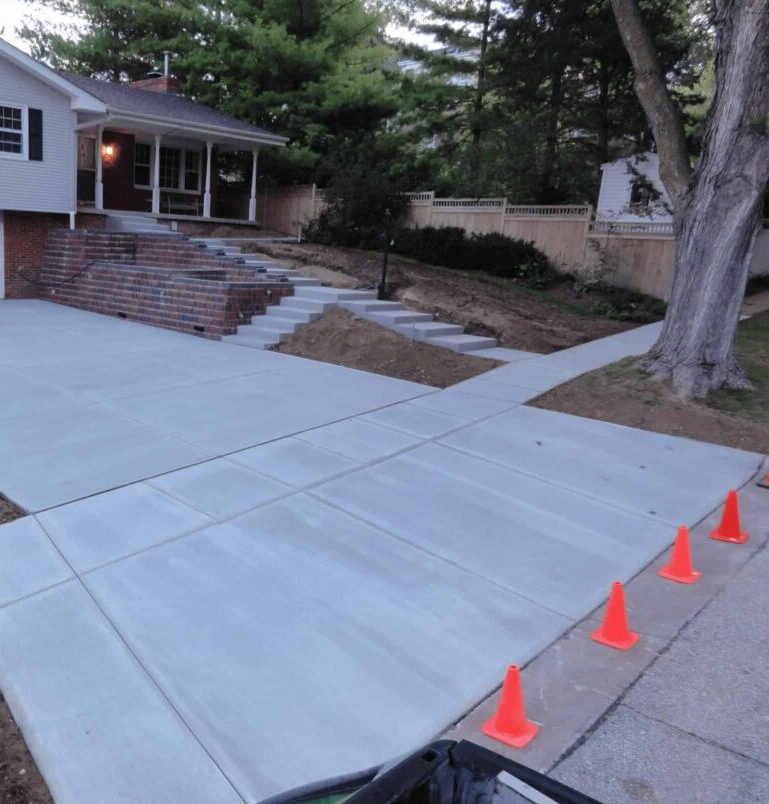
Surface problems are repairable. Flaking, spalling, dusting, hairline cracks, stained or worn concrete — the slab underneath is intact and only the top has gone. That's a concrete resurfacing or concrete repair job at a fraction of the cost of a rebuild.
Structural problems aren't. If sections have dropped, if slabs are separated at the joints, or if the concrete is broken clean through, the base underneath has failed. Resurfacing over that hides it for a season, then the same crack comes back through your new surface.
We do repair, resurfacing and full driveway replacement in-house. So when we tell you which one you need, it isn't because it's the only thing we're set up to do.
Five signs your driveway needs attention
Worth checking before it becomes the expensive version of the same problem.
- You can fit a coin into a crack. Anything wider than a credit card edge is letting water into the base. In a GTA winter that water freezes, expands and makes the crack bigger every year.
- One side of a crack sits higher than the other. Run your foot across it. If you feel a step, the ground underneath has moved — that's structural, not cosmetic.
- The surface sheds grey dust or flakes off in sheets. Spalling. Almost always freeze-thaw and road salt attacking a surface that wasn't sealed or wasn't finished properly.
- Water pools instead of running off. Either the grade has settled or it was never right. Standing water accelerates every other problem on this list.
- The section by the garage has dropped. That's where the base is usually weakest and where vehicle load concentrates. Often the first place a driveway fails.
Concrete driveway problems we repair
The six issues we're called out for most, and what each one usually means.
Cracked concrete
Hairline cracks are normal and repairable. Wide cracks with the sides at different heights mean movement underneath — that's a different conversation.
Spalling & flaking
The top layer lifting off in sheets or chips. Almost always freeze-thaw and road salt. Surface-only, and one of the most repairable problems there is.
Sunken or settled slabs
One section sitting lower than the next. The granular base has washed out or was never compacted properly. Needs addressing from below, not above.
Crumbling edges
Broken corners and edges where the driveway meets the garage, the curb or the lawn. Rebuilt to shape and made sound.
Pitting & dusting
A rough, pockmarked surface that sheds fine grey dust. Usually a bad original finish or a mix that wasn't right. Resurfacing solves it permanently.
Oil stains & discolouration
Cosmetic, but it's often why people call. Grinding and a new surface deals with it — and a sealed finish stops it happening again.
Repair vs resurface vs replace
Side by side, so you can see which one your driveway is.
| Repair | Resurface | Replace | |
|---|---|---|---|
| Best for | Localised damage on a sound slab | Surface failure across a wide area | Base failure, settlement, broken through |
| Typical cost | $3,000 – $6,000 | $8,000 – $16,000 | $15,000 – $26,000 |
| Time on site | 1–2 days | 2–3 days | 3–5 days |
| Result | Sound and safe, repairs visible | Looks like a new driveway | Is a new driveway |
| Warranty | Written, job-specific | 10 yrs Graniflex / 3 yrs overlay | Written, job-specific |
| Lifespan added | 5–10 years | 10–20 years | 25–40 years |
Costs are before HST and depend on size, access and condition. For a figure specific to your driveway, text us three photos — written quote back within one business day.
Which one is yours?
Repair
When: damage is localised. One cracked section, a broken edge, a few problem spots — and the rest is sound.
Cracks opened out and filled with rapid-hardening repair mortar, damaged sections rebuilt to shape, joints resealed.
Resurface
When: the surface has gone across a wide area but the slab underneath hasn't moved.
Repairs first, then a new bonded surface over the whole driveway — Graniflex with a 10-year warranty, or a concrete overlay with 3 years.
Replace
When: the base has failed. Sections dropped, slabs broken through, water pooling where it shouldn't.
Full removal, excavation, recompacted granular base, reinforced and repoured with proper slope. See new concrete driveways.
How a concrete driveway repair actually goes
Concrete fails from the bottom up. Almost every driveway we tear out failed because of what was — or wasn't — underneath it.
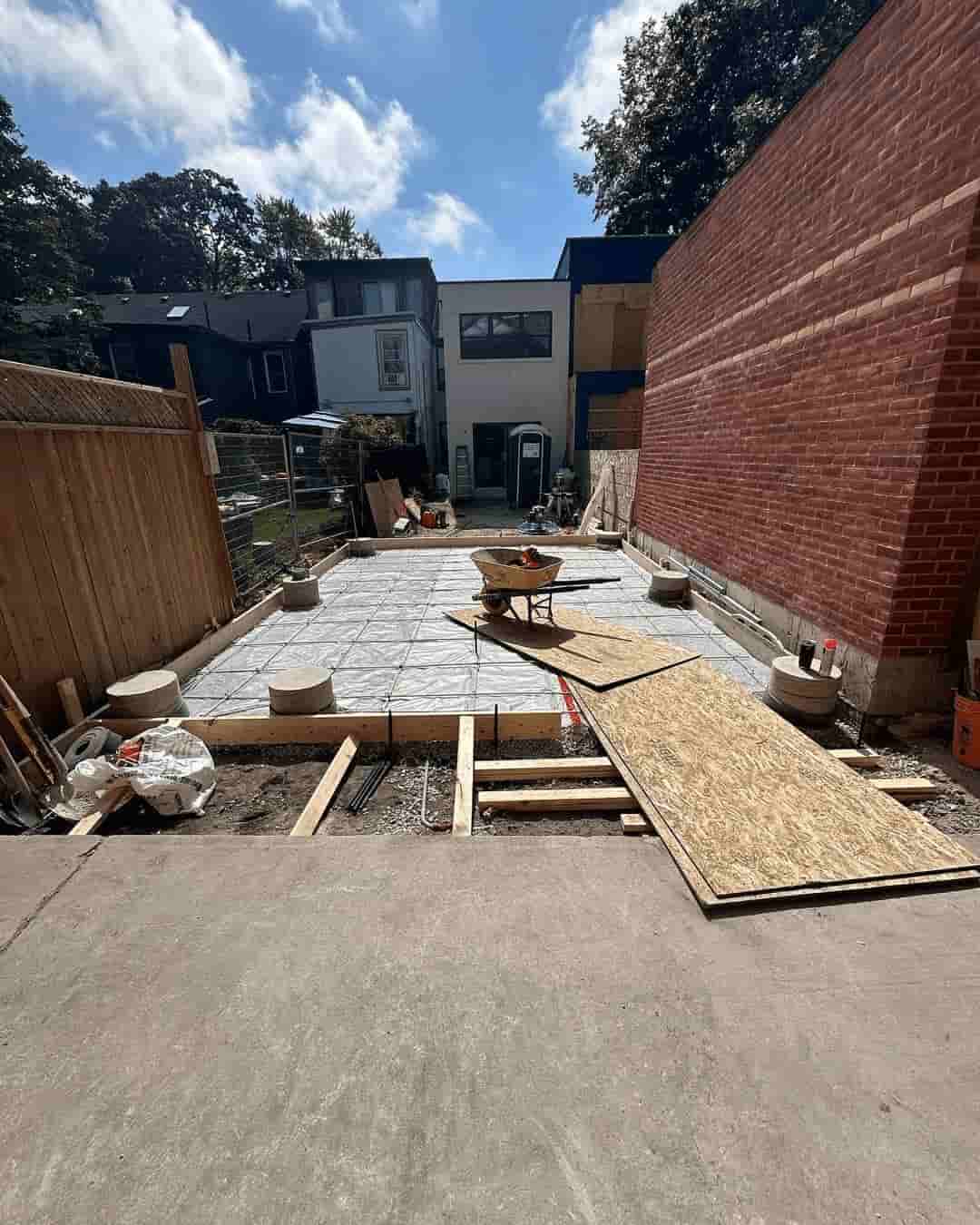
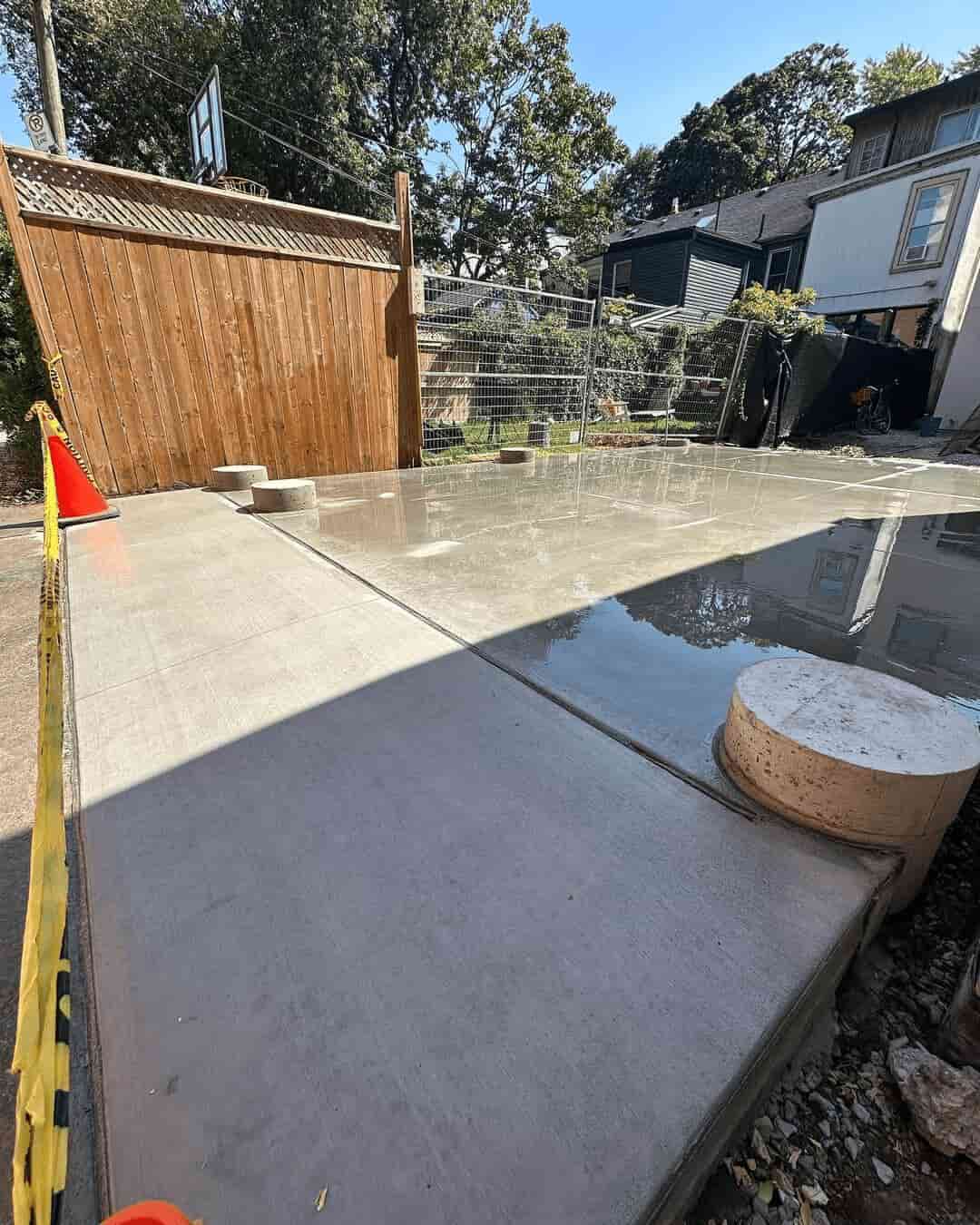
- AssessmentFrom your photos, or on site. We're looking for one thing above all: has anything moved, or is this surface only? That single answer decides everything else.
- PreparationThe area is protected, the surface mechanically ground to remove loose and failed material, and everything cleaned back to sound concrete.
- RepairsCracks opened out and filled. Broken edges and corners rebuilt to their original shape. Joints cleaned and prepared.
- SurfaceIf you've chosen a finish, it goes on now — Graniflex, overlay or a sealed broom finish. Colour and texture to suit the house.
- Curing & handoverWe tell you exactly when you can walk on it and when you can park on it. Those dates are in your quote, not a surprise at the end.
Why concrete driveways fail in the GTA
Toronto is a hard place for concrete. Worth knowing what you're up against.
Freeze-thaw cycles
Water gets into the surface, freezes, expands and lifts the top layer away. It's the single biggest reason GTA driveways spall. Air-entrained mix and proper curing resist it — a cheap pour doesn't.
Road salt
Salt drips off vehicles all winter and accelerates surface breakdown badly. A sealed or coated driveway survives it far better than bare concrete.
Base movement
If the granular underneath wasn't compacted in proper lifts, it settles. The slab has nothing to sit on, and it cracks or drops — however good the concrete was.
Poor drainage
A driveway sloped toward the house sends water where you least want it. Grade is set before the pour, and it isn't something a repair can fix afterwards.
How long should a concrete driveway last?
A properly built concrete driveway in the GTA should give you 25 to 40 years. Most of the ones we're called to have failed well before that, and it's almost never the concrete's fault — it's what went underneath, or what didn't go on top.
The two things that shorten a driveway's life more than anything else are an uncompacted base and an unsealed surface. The first is decided on the day it's poured and can't be corrected later. The second is fixable at any point, which is why resurfacing a tired but structurally sound driveway is often the best money you'll spend on it.
What you get from us
- Two or three priced options — where repair or resurfacing is genuinely viable, you'll see it costed next to replacement. You choose.
- Nothing due upfront — 50% the day our crew arrives and starts work, 50% when it's finished.
- Price held 21 days from the date the quote is sent.
- Written warranty — terms in the quote before you sign, not produced afterwards.
- Photos of every stage so you can see what went in underneath the finished surface.
What people say after the job
"Invoiced at the quoted price"
They spent time assessing and quoting the job and did the work as quoted, including explaining what they were doing and asking for direction when needed. The work was done in the time they estimated. The on-site crew were professional, courteous and friendly, they did a good job cleaning up, the finished work was inspected and the job was invoiced at the quoted price.
"A string of trades — most fell below professional standards"
From beginning to end, these guys were consummate professionals and an absolute pleasure to deal with. This rebuild has seen a string of trades, most of whom fell way below professional standards. That is why we were so grateful for the breath of fresh air from the work crew — these guys clearly took true pride in their work. They were meticulous, courteous, clean, and efficient.
Concrete driveway repair questions
Can a cracked concrete driveway be repaired, or does it need replacing?
Most cracked driveways can be repaired. Hairline and surface cracks are routine repair work. What can't be repaired is a driveway where sections have settled at different heights, or where the slab is broken clean through — that means the base underneath has failed, and any repair on top will crack again in the same place. A quick test: if you can feel a step between the two sides of a crack, it's likely structural. If it's flat across, it's likely surface.
How much does concrete driveway repair cost in Toronto?
Localised repairs typically run $3,000 to $6,000. Resurfacing a full driveway usually lands between $8,000 and $16,000 depending on size and system. Full replacement is generally $15,000 to $26,000. All before HST, and all dependent on size, access and condition. Text us three photos and you'll have a written figure for your driveway within one business day.
Is it cheaper to repair or replace a concrete driveway?
Repair is considerably cheaper in the short term — often a third of the cost of replacement. The real question is whether repair will hold. On a driveway with a sound base, repair and resurfacing is far better value and buys you another decade or two. On one where the base has failed, repair is money spent twice, because the same problem resurfaces within a season or two. That's the assessment we do first, and we'll tell you honestly which situation you're in.
How long does driveway repair take?
Localised repairs are usually one to two days on site. A full resurfacing is typically two to three days. Full replacement runs three to five days depending on size and how much demolition is involved. Curing time comes after that, and we give you specific dates for walking on it and parking on it.
When can I park on a repaired driveway?
It depends on the work. Crack repairs and patching are usually ready for vehicles within a day or two. A resurfaced driveway needs longer for the new surface to fully cure, and new concrete longer still — concrete keeps gaining strength for weeks after a pour, and driving on it too early is one of the most common ways a good driveway gets damaged in its first month. We give you exact dates rather than general advice.
Will a repair match the rest of my driveway?
Honestly, a spot repair rarely matches perfectly. New concrete cures a different shade to concrete that's been weathering for fifteen years. That's why we often recommend repairing and then resurfacing the whole area — it costs more, but you get one uniform surface rather than a driveway with obvious patches. If matching isn't a concern for you, repair alone is the cheaper route and we'll say so.
Can you resurface a concrete driveway instead of replacing it?
Yes, provided the slab underneath is structurally sound. Resurfacing bonds a new wearing surface over the existing concrete after repairs are made. Graniflex carries a 10-year warranty and a concrete overlay carries 3 years. It costs roughly half of a full replacement and the finished result looks like a new driveway. It won't work where the base has settled, because the new surface will crack along the same lines as the old one.
What time of year can driveway repairs be done?
Exterior concrete work runs from roughly May through October in the GTA, when temperatures stay reliably above freezing through the curing period. Cold-weather work is possible with blankets and mix adjustments, but it costs more and carries more risk. If waiting until spring is the better call, we'll tell you rather than take the job.
Do you repair driveways with heaving or sunken slabs?
We assess them, yes. Heaving and settlement are base problems rather than surface problems, and the honest answer is often that the affected section needs removing and repouring rather than lifting or patching. Where only one section has failed, we can sometimes replace that and resurface the rest so it reads as one driveway. Photos taken low down along the surface show us the drop clearly.
Do I need a permit to repair my driveway in Toronto?
Repairs and resurfacing generally don't require a permit. Full replacement can, particularly if you're changing the width, the curb cut or the drainage. We've worked within City of Toronto and GTA permit requirements for years and will tell you during the assessment whether yours needs one.
Related concrete services
Next step
Find out what yours actually needs
Three photos is all it takes. Here's what makes them useful:
Back to you within one business day · Nothing due until our crew is on site · No one will chase you
Concrete driveway repair across Mississauga, Etobicoke, North York, Scarborough, Vaughan, Brampton, Oakville, Richmond Hill and the wider GTA.